The Manila galleons
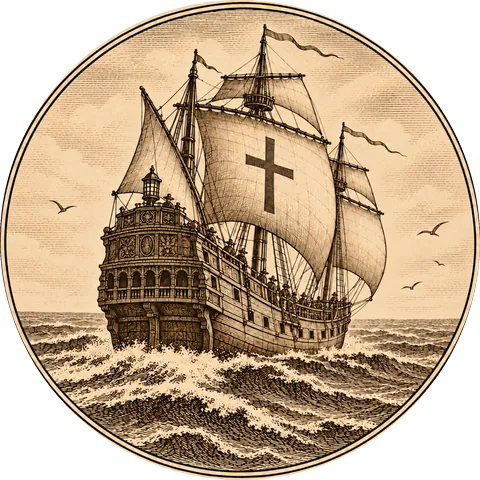
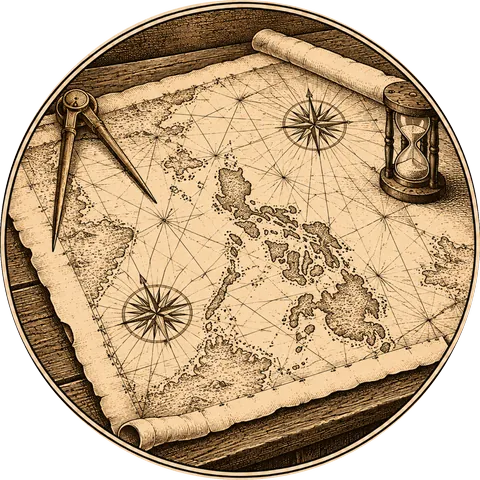
For 250 years, from 1565 to 1815, Spanish ships called the Manila galleons crossed the Pacific between Manila and Acapulco, in Mexico. They carried Chinese silk and porcelain east and Mexican silver west, and tied the Philippines to the Americas. The route they followed was found in 1565 by the San Pedro, with the friar Andrés de Urdaneta aboard.

- Ports
- Manila and Acapulco
- Years
- 1565–1815
- Route found
- By the San Pedro, with Andrés de Urdaneta aboard, in 1565
- Manila to Acapulco
- North to the westerly winds, then east across the North Pacific: four to six months, sometimes more
- Acapulco to Manila
- West with the trade winds, by way of Guam: about three months
- Eastbound cargo
- Chinese silk and porcelain, with spices, ivory and lacquerware
- Westbound cargo
- Silver, with soldiers, officials, friars, and plants from the Americas
- Ships
- One or two a year each way; from 1593 the crown allowed only two
- The end
- Abolished by the Spanish Cortes in 1813; the last galleon reached Manila in 1815
The problem: no way back
Ships could sail west across the Pacific easily, because the trade winds of the tropics blow from the east for most of the year. But every ship that tried to sail back was beaten by the same winds: Magellan’s Trinidad in 1522, Saavedra’s Florida in 1528 and 1529, Villalobos’s ships in 1543 and 1545. Without a way back, Spain could reach Asia across the Pacific, but not trade there or stay. (Chapter 1 and Chapter 2)
So when King Felipe II ordered a new expedition in 1559, finding the way back was the point. “The principal reason of this expedition,” he wrote, “is to ascertain the return voyage.” (Chapter 3)
Urdaneta’s answer: sail north
Urdaneta, who had seen the failures for himself, planned to sail north, out of the trade winds, into the westerly winds that blow across the Pacific far to the north. On 1 June 1565 the San Pedro left Cebu at the start of the southwest monsoon, with about two hundred people aboard, under Legazpi’s grandson Felipe de Salcedo. She climbed to a little over 39 degrees north, the latitude of northern Japan, and ran east before the westerlies, helped by the warm current now called the Kuroshio. (Chapter 17 and Chapter 18)
On 18 September she sighted an island off California, and followed the coast south. Sixteen people died, among them the chief pilot, Esteban Rodríguez, and at the end only ten to eighteen men were fit to work the ship. She reached Acapulco on 8 October 1565, about four months after leaving Cebu. (Chapter 19)
… we reached this port of Acapulco on the eighth of this present month of October after all the crew had endured great hardships.
Rodrigo de Espinosa, pilot of the San Pedro
Who found the way back?
Urdaneta gets the credit: the route was his plan, the San Pedro’s log recorded it, and the galleons followed it. But the first ship to cross was the San Lucas, a small patache that had left Legazpi’s fleet in 1564. She reached Navidad on 9 August 1565, two months before the San Pedro, and her captain, Alonso de Arellano, was charged with desertion. Legazpi asked the king to reward the San Pedro’s young captain, his grandson Felipe de Salcedo. (Chapter 18 and Chapter 19)
The route
Acapulco to Manila
The westbound galleons left Acapulco early in the year, usually in March, and ran west with the trade winds, a little north of the equator, as Legazpi’s fleet had in 1564. Near the end of a voyage of about three months they called at Guam, then entered the islands by the San Bernardino Strait, between Luzon and Samar, and sailed on to Manila. (Chapter 5 and Chapter 7)
Manila to Acapulco
The eastbound galleons left Manila Bay in early summer, threaded the islands to the San Bernardino Strait, and headed north-east, past Japan, to the latitudes of the westerlies. There they crossed the North Pacific, sighted the coast of California, and followed it south to Acapulco. The crossing took four to six months and sometimes more: one of the longest, coldest and hungriest voyages of its age, on which scurvy killed many.
Silk for silver
After Manila was founded in 1571, Chinese merchants came in greater numbers every year, bringing silk, porcelain and other goods to sell for silver. The galleons carried these goods across the Pacific to Acapulco, and came back with silver coins from the mines of Mexico and Peru, which China wanted above all. Historians often date the start of truly worldwide trade to 1571, when Manila linked Asia to the Americas, and through them to Europe. (Chapter 27 and Chapter 28)
Westbound, the galleons also carried soldiers, officials and friars, money to run the colony, and plants from the Americas, among them maize, tobacco, cacao and sweet potato. From 1593 the crown allowed only two ships a year each way, to protect the merchants of Spain.
Danger
Galleons were wrecked by storms and typhoons, or captured by Spain’s enemies. The first one lost was Legazpi’s own San Pablo, wrecked at Guam in 1568 on her way to Mexico; her crew survived. English captains took the Santa Ana off Baja California in 1587 and the Covadonga off Samar in 1743.
What the galleons left behind
People crossed as well as goods. Filipino sailors and settlers made homes on the Pacific coast of Mexico, and are credited with bringing tuba, coconut palm wine, which is still sold under that name in Colima. Mexican soldiers, priests and officials went to the Philippines. Words came with the plants: kamote, sayote, singkamas, tsokolate and tiyangge, a market, all come from Nahuatl, the language of the Aztecs, by way of Mexican Spanish.
The end of the galleons
The Spanish parliament, the Cortes of Cádiz, abolished the galleon trade in 1813, while Mexico was fighting for its independence. The last galleon, the Magallanes, came back to Manila in 1815. In 2009, at the Philippines’ proposal, UNESCO adopted 8 October, the day the San Pedro reached Acapulco, as the Día del Galeón, Galleon Day, first celebrated in Manila in 2010.
If you are writing about it
- Explain the winds: why sailing west across the Pacific was easy, and sailing back was not.
- Give Urdaneta the credit for the route, and mention the San Lucas, which got back first.
- Say what went each way: silk and porcelain east, silver west.
- Use the key years: 1565, when the route was found; 1571, when Manila was founded; 1815, the last galleon.
Follow the San Pedro on the map →
Quotations follow the English translations in Emma Helen Blair and James Alexander Robertson’s The Philippine Islands, 1493–1898. About the sources →
More about the voyage: Timeline · Who’s who · How the Philippines got its name · The blood compact · The founding of Manila