The founding of Manila
Spanish Manila was founded in June 1571 by Miguel López de Legazpi, who gave it the title of city on 3 June and named its first city council on 24 June, the day Manila keeps as its founding day. But Manila was not new. It was built on the ashes of Maynila, a fortified trading town at the mouth of the Pasig River, ruled by Rajah Sulayman and his uncle, which the Spaniards had burned the year before.
- Before the Spaniards
- Maynila, a fortified Muslim trading town at the mouth of the Pasig River, ruled by Rajah Sulayman and his uncle, the elder rajah; across the river, Tondo, ruled by Lakandula
- First Spanish attack
- 24 May 1570, by Martín de Goiti and Juan de Salcedo
- Legazpi arrives
- Mid-May 1571
- Title of city
- 3 June 1571
- First city council
- 24 June 1571
- Celebrated
- Every 24 June, as Manila Day, Araw ng Maynila
Maynila before the Spaniards
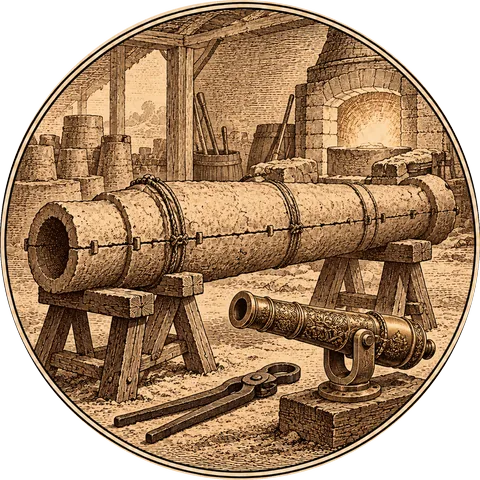
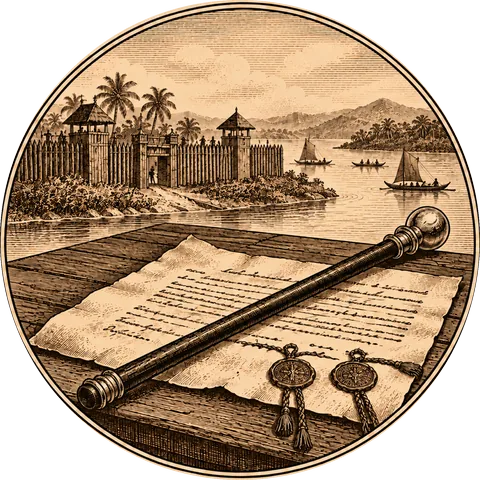
Maynila stood on the south bank of the Pasig River where it meets Manila Bay, behind a palisade with guns at its gates. Its rulers were Muslims, with close ties to the sultanate of Brunei, on Borneo. Chinese junks came every year to trade, and forty Chinese families and twenty Japanese lived in the town. Beside Sulayman’s house stood a foundry where bronze cannon were cast, with moulds of clay and wax for guns up to seventeen feet long. The town may have had about two thousand people. Its name is usually said to come from nilad, a flowering plant that grew along the river. (Chapter 25 and Chapter 27)
Across the river lay Tondo, ruled by Lakandula. Neither ruled the other towns of the bay: a single village might have “five, six, or ten chiefs,” the Spaniards found, and no one ruled them all. (Chapter 26)
1570: Goiti and Sulayman
In May 1570 Legazpi sent his master-of-camp, Martín de Goiti, and his own grandson, Juan de Salcedo, north from Panay with about ninety Spanish soldiers and hundreds of Visayan allies. At Mindoro the people told them that they “were crazy to go to Manilla with so small a force.” (Chapter 24)
At Maynila the young Rajah Sulayman met Goiti at the water’s edge. He was glad to be the Spaniards’ friend, he said:
… but the latter should understand that the Moros were not painted Indians.
Rajah Sulayman, in the Spanish account of 1570
They would not put up with mistreatment, as others had; they “would repay with death the least thing that touched their honor.” Goiti made a compact of blood with Sulayman and his uncle, but nobody laid down their weapons. On the morning of 24 May the guns of Maynila fired on the Spanish ships, and the Spaniards stormed the palisade. The town burned. On 6 June Goiti took possession of Luzon for the king, then sailed back to Panay. Legazpi was not pleased: he had meant to make Maynila his home. (Chapter 25)
1571: Legazpi and Lakandula
In April 1571 Legazpi himself sailed for Luzon, with about 230 soldiers and twenty-six or twenty-seven ships. When his fleet entered Manila Bay in mid-May, the people of Maynila set fire to their rebuilt town and crossed the river to Tondo. That afternoon Lakandula came out in a small boat to welcome Legazpi “in peace and friendship,” and asked him to pardon Sulayman and the elder rajah for the fighting of the year before. On 16 May Legazpi stepped ashore at Maynila, and the three chiefs declared themselves his friends. (Chapter 26)
3 June 1571: Bangkusay
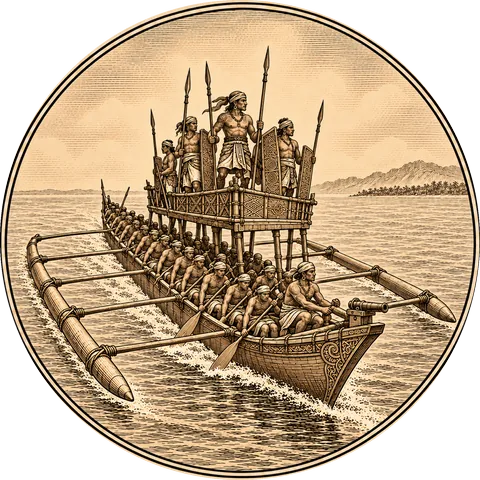
Not every town wanted peace. Warriors from the towns north of the bay, among them Macabebe in Pampanga, came against the Spaniards in twenty or thirty war boats on 3 June, the feast of Pentecost. Goiti met them with seventy soldiers and the Visayan allies, in boats lashed together in pairs. The attackers were driven ashore, and their leader, the young chief of Macabebe, was killed. The prisoners were divided among the soldiers as slaves, “reserving a fifth for his Majesty.” (Chapter 26)
The Spanish records do not give the young chief’s name. He is remembered as Tarik Sulayman, a name given about three hundred years later by people who said they were his descendants, and in 2016 the National Historical Commission put up a marker at Macabebe to a nameless young hero. He was not Rajah Sulayman of Maynila, who had made peace with Legazpi a few weeks before.
3 and 24 June 1571: the city
On 3 June, the day of the battle, Legazpi gave Manila the title of a Spanish city. On 24 June, St John’s Day, he named its first city council: two alcaldes, or magistrates, a chief constable, and twelve regidores, or councillors. A year later the notary Hernando Riquel certified that Legazpi “gave the title of city to this colony of Manila, on the third day of the month of June.” (Chapter 27)
Legazpi promised land and repartimientos, grants of the tribute of the people, to every Spaniard who would settle as a citizen, and Manila became the seat of Spanish government in the islands. The Spanish city rose on the ashes of Sulayman’s town, where Intramuros, the walled city, stands today. (Chapter 27)
After 1571
In August 1571 Juan de Salcedo took the town of Cainta, up the Pasig, where four hundred of its people were killed, and the towns around Laguna de Bay made peace. Legazpi died in Manila on 20 August 1572. In November 1574 the Chinese corsair Limahong attacked the young city, and Goiti was killed before the attackers were driven off. That year King Felipe II confirmed Manila’s title of city, calling it insigne y siempre leal, distinguished and ever loyal. The stone walls of Intramuros came later, from the end of the 1500s. (Chapter 27 and Chapter 28)
Why 24 June?
Manila keeps 24 June as its founding day because its first city council was named that day, although Legazpi had given it the title of city on 3 June. Every 24 June is Manila Day, Araw ng Maynila, a special holiday in the city.
If you are writing about it
- Give both dates: the title of city on 3 June 1571, and the first city council on 24 June 1571.
- Say that Maynila was there long before: a fortified trading town with its own foundry and foreign merchants.
- Name the rulers: Rajah Sulayman and his uncle in Maynila, Lakandula in Tondo.
- Don’t confuse Rajah Sulayman with the nameless chief of Macabebe killed at Bangkusay.
Quotations follow the English translations in Emma Helen Blair and James Alexander Robertson’s The Philippine Islands, 1493–1898. About the sources →
More about the voyage: Timeline · Who’s who · How the Philippines got its name · The blood compact · The galleon trade