The blood compact
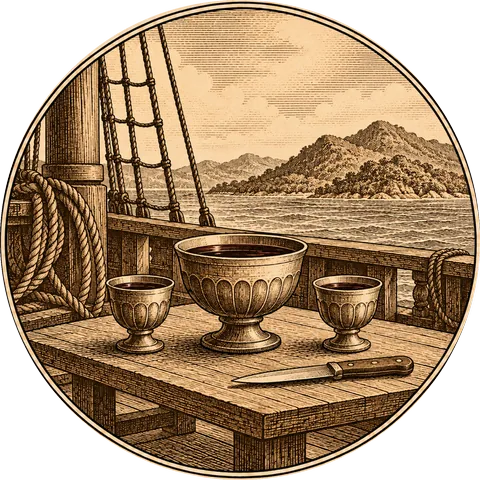
In March 1565, on the island of Bohol, Datu Sikatuna and another chief, Sigala, made friendship with Miguel López de Legazpi by the custom of the islands: each side drew a few drops of blood, mixed them with wine, and drank. In the Philippines it is called the Sandugo, “one blood” in Visayan, and it is the best-known moment of Legazpi’s voyage.
- Who
- Datu Sikatuna and Sigala, chiefs on Bohol, and Miguel López de Legazpi
- When
- March 1565: by tradition 16 March; by the National Historical Institute’s finding of 2005, 25 March
- Where
- Bohol: by tradition at Bool, in Tagbilaran; by the 2005 finding, aboard the San Pedro off Loay
- What
- A ritual of friendship common in the islands, which the Spaniards made several times
- Remembered
- Blood Compact Day, 16 March, in Bohol; the Sandugo Festival every July in Tagbilaran; Juan Luna’s painting of 1886
Why Sikatuna made friends
Legazpi reached Bohol in mid-March 1565, after weeks of finding the islands wary and empty. A captured junk from Borneo explained why. About two years before, Portuguese raiders from the Moluccas had come through the islands with eight large praus, “saying that they were Castilians, and vassals of the king of Castilla.” When people trusted them, they attacked, and on Bohol alone, Legazpi was told, they killed or carried off more than a thousand people. Legazpi tried to explain that the Portuguese served a different king. The people answered that the strangers looked the same: they “wear the same kind of clothing, and carry the same weapons.” (Chapter 10)
The Bornean pilot went inland, and came back with two chiefs, Sikatuna and Sigala. They told Legazpi the same story, and then made friendship with him by the custom of the islands. (Chapter 11)
How it was done
Legazpi’s men had already made blood-friendship on Samar and at Cabalian, on Leyte, and he described the ceremony carefully. Each side drew “two or three drops of blood from his arm or breast,” and mixed them “in the same cup, with water or wine.” The mixture was divided between two cups, “and neither person may depart until both cups are alike drained.” It was, he wrote, “a ceremony that is considered inviolable.” (Chapter 8, Chapter 9 and Chapter 11)
Did Legazpi trust it?
Not at first. “Although Çicatuna and Çigala made friendship with me,” he wrote, “we could put no confidence in them; nor would they sell us anything, but only made promises.” (Chapter 11)
Yet the friendship held. When a frigate Legazpi had sent to scout Cebu was three weeks overdue, Sikatuna and Sigala went in a boat to Cebu themselves to look for it. Only the Spanish side of the compact was written down; what Sikatuna expected from it we can only judge from what he did. (Chapter 12)
When and where?
Legazpi names Sikatuna and Sigala but gives no date or place, so both have been argued over.
- 16 March 1565, at Bool. The traditional date and place, on the coast of what is now Tagbilaran City. Republic Act No. 9093 of 2001 made 16 March Blood Compact Day in Bohol, and the Blood Compact Shrine at Bool has a bronze of the scene by the National Artist Napoleon Abueva.
- 25 March 1565, off Loay. In 2005 the National Historical Institute, after studying the documents and inspecting the coast, concluded that the compact was made aboard Legazpi’s flagship, the San Pedro, anchored off Hinawanan Bay, in Loay. In 2017 the National Historical Commission asked the provincial government to remove the marker at Bool, which disagreed with the one at Loay.
Both places still mark it: Tagbilaran with its shrine and the Sandugo Festival every July, and Loay with its own marker and statues, unveiled for the 450th anniversary in 2015.
Was it the first blood compact?
No. On Good Friday, 29 March 1521, at Limasawa, Magellan and the king of Mazaua, Rajah Kolambu, agreed to be casi casi, blood brothers. At Cebu that April, Rajah Humabon asked Magellan to send a drop of blood from his right arm as a sign of friendship, and promised to do the same. On Mindanao in May 1521, Pigafetta watched a king draw blood from his hand and mark his body, his face and his tongue with it, “as a token of the closest friendship.” (Mazaua, Zubu and The Burning of the Concepción, in Pigafetta’s Log)
Nor was it the last. In May 1570, at Maynila, Martín de Goiti made a compact of blood with Rajah Sulayman and his uncle: they drank his blood mixed with wine, and he drank theirs. Within days they were fighting. (Chapter 25)
The painting
The 1565 compact is the famous one because of a painting. Juan Luna painted El Pacto de Sangre, The Blood Compact, in Paris in 1886, while he studied in Europe on a scholarship from the city council of Manila, and gave it to the city. It shows Legazpi and Sikatuna drinking together at a table, with Spaniards around them. José Rizal posed for Sikatuna, and Trinidad Pardo de Tavera for Legazpi. It hangs today in Malacañan Palace, at the top of the Grand Staircase.
What it came to mean
In the late 1800s Filipino reformers saw in the compact a treaty of friendship between equals that Spain had not honoured, and Luna’s painting gave it a face. The members of the revolutionary society the Katipunan signed their oaths in their own blood. In Bohol today the Sandugo stands for friendship, and every July the Sandugo Festival celebrates it.
If you are writing about it
- Quote Legazpi’s own description of the ceremony: it is the only account from 1565.
- Say which date you use, and why: 16 March is the traditional date and Bohol’s holiday; 25 March is the National Historical Institute’s finding of 2005.
- Don’t confuse it with Magellan’s blood brotherhood with Kolambu at Limasawa in 1521.
- Remember that only the Spanish side was written down.
Read the blood compact chapter →
Quotations follow the English translations in Emma Helen Blair and James Alexander Robertson’s The Philippine Islands, 1493–1898. About the sources →
More about the voyage: Timeline · Who’s who · How the Philippines got its name · The galleon trade · The founding of Manila